Items filtered by date: October 2025
Are You Suffering From Ingrown Toenails?

If left untreated, an ingrown toenail can lead to more serious concerns, such as an infection. Knowing proper nail care can help in the prevention of an ingrown toenail. Give us a call, and get treated!
Understanding the Achille’s Tendon

The Achilles tendon is the largest and strongest tendon in the human body, connecting the calf muscles, the gastrocnemius and soleus, to the heel bone, or calcaneus. Structurally, it is composed of dense collagen fibers arranged in parallel bundles that provide both strength and flexibility. These fibers allow the tendon to withstand high tension during activities like walking, running, and jumping. The tendon is surrounded by a sheath that helps reduce friction and provides lubrication for smooth movement. Functionally, the Achilles tendon plays a key role in movement and stability. It transmits the powerful force generated by the calf muscles to lift the heel off the ground, enabling push-off during walking or sprinting. It also helps maintain balance and absorb shock during impact. Because of the stress it endures, the Achilles tendon is prone to overuse injuries, especially in athletes and active individuals. If you have Achilles tendon pain, it is suggested that you see a podiatrist for a diagnosis and appropriate treatment.
Achilles tendon injuries need immediate attention to avoid future complications. If you have any concerns, contact Elliot T. Udell, DPM of New York. Our doctor can provide the care you need to keep you pain-free and on your feet.
What Is the Achilles Tendon?
The Achilles tendon is a tendon that connects the lower leg muscles and calf to the heel of the foot. It is the strongest tendon in the human body and is essential for making movement possible. Because this tendon is such an integral part of the body, any injuries to it can create immense difficulties and should immediately be presented to a doctor.
What Are the Symptoms of an Achilles Tendon Injury?
There are various types of injuries that can affect the Achilles tendon. The two most common injuries are Achilles tendinitis and ruptures of the tendon.
Achilles Tendinitis Symptoms
- Inflammation
- Dull to severe pain
- Increased blood flow to the tendon
- Thickening of the tendon
Rupture Symptoms
- Extreme pain and swelling in the foot
- Total immobility
Treatment and Prevention
Achilles tendon injuries are diagnosed by a thorough physical evaluation, which can include an MRI. Treatment involves rest, physical therapy, and in some cases, surgery. However, various preventative measures can be taken to avoid these injuries, such as:
- Thorough stretching of the tendon before and after exercise
- Strengthening exercises like calf raises, squats, leg curls, leg extensions, leg raises, lunges, and leg presses
If you have any questions please feel free to contact our office located in Hicksville, NY . We offer the newest diagnostic tools and technology to treat your foot and ankle needs.
What Does a Podiatrist Do for Your Foot Health?

A podiatrist is a medical specialist dedicated to diagnosing and treating conditions affecting the feet, ankles, and lower legs. People often seek podiatric care for symptoms such as pain, swelling, numbness, deformities, or difficulty walking. Common causes include injuries, arthritis, infections, structural abnormalities, or chronic diseases like diabetes. Foot problems may look like swelling, redness, or changes in skin or nail appearance. Visible deformities, such as bunions or hammertoes, might also be present. A podiatrist uses a comprehensive approach, including physical examinations, imaging tests, and patient history, to identify the root cause of foot or ankle issues. Treatment options include conservative measures like custom orthotics and medications, as well as advanced interventions such as surgery or wound care. Early diagnosis and proper management can prevent complications and improve quality of life. For personalized foot care and expert advice, it is suggested that you schedule an appointment with a podiatrist.
If you are dealing with pain in your feet and ankles, you may want to seek help from a podiatrist. Feel free to contact Elliot T. Udell, DPM from New York. Our doctor can provide the care you need to keep you pain-free and on your feet.
What Is a Podiatrist?
A podiatrist diagnoses and treats conditions of the foot, ankle, and related structures of the leg. Your podiatrist may specialize in a certain field such as sports medicine, wound care, pediatrics, and diabetic care. Podiatrists have the ability to become board certified through training, clinical experience, and then taking an exam.
What Do Podiatrists Do?
On a daily basis, a podiatrist may perform the following activities:
- Diagnose foot ailments such as ulcers, tumors, fractures, etc.
- Use innovative methods to treat conditions
- Use corrective orthotics, casts, and strappings to correct deformities
- Correct walking patterns and balance
- Provide individual consultations to patients
It is very important that you take care of your feet. It’s easy to take having healthy feet for granted, however foot problems tend to be among the most common health conditions. Podiatrists can help diagnose and treat a variety of feet related conditions, so it is crucial that you visit one if you need assistance.
If you have any questions, please feel free to contact our office located in Hicksville, NY . We offer the newest diagnostic and treatment technologies for all your foot care needs.
Heel Pain Linked to Nerve Entrapment

Heel pain is a frequent complaint, and while many cases are linked to plantar fasciitis, nerve entrapment can also be a significant cause. One overlooked source is called Baxter’s nerve entrapment, which involves the first branch of a nerve that passes through tight spaces in the heel. This nerve can become compressed by certain muscles, a heel spur, or excess strain from foot pronation. When trapped, the nerve may produce sharp pain that radiates along the heel, often worsening at night or after activity. Some people may also notice weakness in the small muscles of the foot. Because the symptoms can mimic other heel conditions, a podiatrist is essential in performing a careful exam to identify the true cause and recommend the right treatment. If you are experiencing heel pain, it is suggested that you make an appointment with a podiatrist for an exam and treatment.
Many people suffer from bouts of heel pain. For more information, contact Elliot T. Udell, DPM of New York. Our doctor can provide the care you need to keep you pain-free and on your feet.
Causes of Heel Pain
Heel pain is often associated with plantar fasciitis. The plantar fascia is a band of tissues that extends along the bottom of the foot. A rip or tear in this ligament can cause inflammation of the tissue.
Achilles tendonitis is another cause of heel pain. Inflammation of the Achilles tendon will cause pain from fractures and muscle tearing. Lack of flexibility is also another symptom.
Heel spurs are another cause of pain. When the tissues of the plantar fascia undergo a great deal of stress, it can lead to ligament separation from the heel bone, causing heel spurs.
Why Might Heel Pain Occur?
- Wearing ill-fitting shoes
- Wearing non-supportive shoes
- Weight change
- Excessive running
Treatments
Heel pain should be treated as soon as possible for immediate results. Keeping your feet in a stress-free environment will help. If you suffer from Achilles tendonitis or plantar fasciitis, applying ice will reduce the swelling. Stretching before an exercise like running will help the muscles. Using all these tips will help make heel pain a condition of the past.
If you have any questions, please feel free to contact our office located in Hicksville, NY . We offer the newest diagnostic and treatment technologies for all your foot care needs.
Types of Corns on the Feet
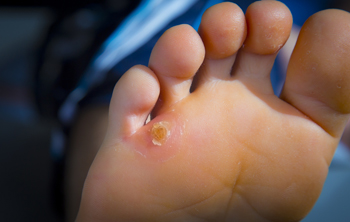
A corn on the foot can develop from excess pressure. This is often the result of wearing shoes that do not fit correctly. The types of corns that can form are referred to as hard and soft corns. The latter gradually develops between the toes and can cause severe pain and discomfort. The top of the corn is often moist, and toes that are crammed together for the majority of the day may cause this to occur. Hard corns can develop on top of the toes, or on the bottom of the feet. Patients who run barefoot may be susceptible to developing a hard corn. Additionally, they can form on top of the toes from wearing shoes that can cause excess friction as walking and running are pursued. If you have a corn on your foot, please consult with a podiatrist who can effectively treat any type of corn.
If you have any concerns regarding your feet and ankles, contact Elliot T. Udell, DPM of New York. Our doctor will treat your foot and ankle needs.
Corns: What Are They? and How Do You Get Rid of Them?
Corns can be described as areas of the skin that have thickened to the point of becoming painful or irritating. They are often layers and layers of the skin that have become dry and rough, and are normally smaller than calluses.
Ways to Prevent Corns
There are many ways to get rid of painful corns such as wearing:
- Well-fitting socks
- Comfortable shoes that are not tight around your foot
- Shoes that offer support
Treating Corns
Treatment of corns involves removing the dead skin that has built up in the specific area of the foot. Consult with Our doctor to determine the best treatment option for your case of corns.
If you have any questions, please feel free to contact our office located in Hicksville, NY . We offer the newest diagnostic and treatment technologies for all your foot care needs.
